
Introduction
Whether you’re diagnosing a vehicle, selecting the correct replacement module, verifying feature content, or ordering a retrofit, your GM vehicle’s RPO codes (Regular Production Options) are the authoritative source for determining exactly how the vehicle was originally built. Unfortunately, GM has changed how these codes are delivered over the years, creating confusion for owners who expect to find a traditional printed label — only to discover that newer vehicles rely entirely on a QR code on a label in an entirely different location.
This guide breaks down the differences between the modern RPO label and the legacy SPID label, explains where to find each, and clarifies how to read them correctly.
What Are RPO Codes?
RPO codes are GM’s three-character option identifiers used to define everything from drivetrain configuration to infotainment hardware to trim packages and calibration-critical options. When determining compatibility for modules, upgrade kits, or replacement parts, the RPO list is often the most accurate single source of truth.
Two Different GM Label Formats
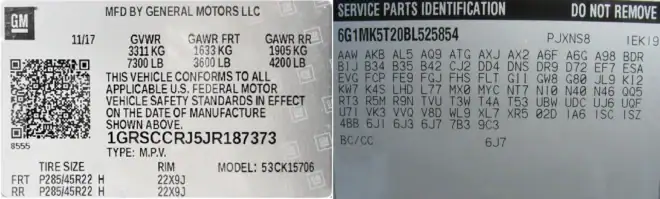
GM vehicles built before approximately 2019 used a printed “Service Parts Identification” (SPID) label containing the full VIN and a complete list of RPO codes. Newer vehicles no longer include this printed list; instead, they use a scannable QR code that links to a digital RPO record.
Here’s the breakdown.
1. Modern GM Vehicles: The RPO QR Label
Where it is located:
On late-model GM vehicles, the RPO label is no longer printed with all of the codes. Instead, a QR code appears on the driver-side B-pillar (door jamb).
What it contains:
This label does not display RPO codes visually. Instead, scanning the QR code retrieves a digital list of all factory RPO codes tied to that VIN.
How to read it:
Use a smartphone camera to scan the QR code. This pulls up the full digital RPO list — far more accurate than relying on dealer build sheets or third-party data.
Why GM switched:
Digital RPO delivery reduces printing errors, avoids label clutter, and ensures the option list matches what GM has stored in its internal systems. It also standardized the location of the label which was an issue with the Legacy SPID labels.
2. Legacy GM Vehicles: The SPID Label
Vehicles produced before model-year 2018 generally used a printed SPID label.
Where it was found:
- In the glove box, or
- On the underside of the spare-tire closeout panel in the trunk (common on sedans and coupes)
What it contained:
- Full VIN
- Entire list of RPO codes printed in alphanumeric groups
This label allowed owners and technicians to identify option content even without digital lookup tools.
Why RPO Codes Matter for Modern GM Electronics
Many GM components — including infotainment modules, clusters, BCMs, cameras, and calibration-critical ECUs — depend on exact feature matching. When ordering parts or determining compatibility, the RPO list confirms:
- Navigation vs. non-navigation configurations
- Audio system variants
- Camera support and park-assist options
- Drivetrain or powertrain specifics
- Trim-level-dependent module variations
Accurate RPO decoding prevents mismatches and ensures that replacement modules behave exactly as the vehicle expects.
Common Misunderstandings
“My new GM vehicle doesn’t have an RPO label.”
It does — but it is now a QR code, not a printed list.
“Scanning the QR code gives incomplete data.”
If scanned properly, it returns the same RPO list GM uses internally. No printed label is more accurate than the digital record. I may be the application on your phone thats not showing the entire list.
“Older vehicles always have the SPID label.”
Most do, but some platforms may have been serviced or had parts replaced over time, which can remove or obscure the label.
Conclusion
Understanding where your GM vehicle’s RPO information is stored — and how to interpret it — is essential for accurate diagnostics, ordering correct replacement modules, and choosing compatible upgrades. Whether your vehicle uses the modern QR-based system or the legacy SPID label, both provide the same critical data GM used when building the vehicle.
If you’re unsure how your RPO codes affect module compatibility or upgrade paths, WAMS can decode them as part of any consultation or order.
Understanding RPO content is a key part of our GM retrofit decision guides.