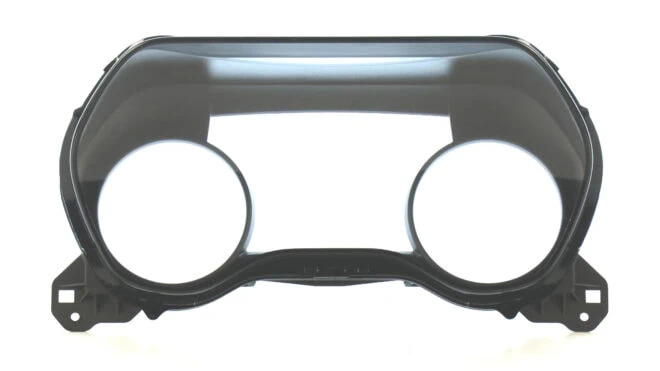
Instrument cluster lenses are one of the most commonly damaged components on modern GM vehicles during service, retrofits, shipping, or handling. What many owners do not realize is that the lens is more than just a piece of clear plastic; it is an optical component engineered for clarity, uniformity, and dust control. Many times the lenses are also coated with a hardened clear coat to resist wear and tear. When scratched, hazed, cracked, or improperly removed, it can permanently affect the appearance of the vehicle’s interior and the readability of the cluster.
This guide covers what the cluster lens is, why it gets damaged, how to identify when replacement is needed, why OEM-quality components matter, and why WAMS is one of the only places where certain lenses can still be sourced.
What Is an Instrument Cluster Lens?
The lens is the clear front cover of the gauge cluster. Its functions include:
- Protecting the cluster face, LCD, and needles
- Providing optical clarity with minimal distortion
- Maintaining a dust-free, sealed environment
- Creating the correct factory gloss and surface finish
- Integrating with trim pieces for proper fitment and alignment
Unlike low-cost aftermarket lenses, OEM lenses are molded to extremely tight tolerances and coated to resist scratches, yellowing, and haze.
Why Are Cluster Lenses Hard to Obtain?
Many GM owners discover an unexpected challenge when they try to source a replacement lens:
1. GM generally does not sell the lens separately as a service part.
At the dealership level, the lens is considered part of the instrument cluster assembly.
It is generally not individually serviceable under normal parts channels.
2. Dealers cannot order replacement lenses.
If the lens is damaged, scratched, or cracked, the dealer solution generally is to replace the entire cluster — often at significant cost.
3. OEM new lenses are extremely limited in availability.
Because the lens is not a standalone GM part, fresh OEM units do not enter regular distribution networks.
4. WAMS sources what the dealer network cannot.
Our offerings include:
- New OEM lenses when available
- Supplier-refurbished lenses that meet OEM clarity, sealing, and fitment standards
- Hard-to-find applications no longer supported through dealer channels
This is why WAMS is one of the only remaining sources for many GM cluster lenses.
To confirm availability for your specific vehicle, you can view the application list here:
Instrument Cluster Lenses — Replacement Parts Category
Why Do Cluster Lenses Get Scratched or Hazy?
Even with careful handling, several common scenarios lead to damage:
Shipping and Packaging
Used clusters purchased online often arrive with scratches or gouges because they were not packaged as optical components.
Improper Cleaning
Using household cleaners, rough paper towels, or abrasive polishes damages the optical coating. Even something as simple as a towel that just isn’t as clean as it should be can wreak havoc on the finish.
Removal or Reinstallation Damage
When removing a cluster for programming or retrofitting, the lens can easily be scratched against trim panels or contacted by tools and clothing.
UV and Environmental Wear
Older clusters often show yellowing or haze.
Aftermarket Part Issues
Low-cost aftermarket lenses frequently warp, distort, or fail to seal properly, allowing dust to enter over time.
When Should You Replace a Cluster Lens?
Replacement is strongly recommended when:
- The lens is scratched, hazy, or scuffed
- Cracks or stress marks appear around the edges or tabs
- A salvage cluster is being used for an upgrade
- UV damage or cleaning-related haze is visible
- You are installing a premium interior or cluster upgrade
A new or factory-refurbished OEM lens restores the correct optical quality and appearance.
Why Use OEM or Factory-Refurbished Lenses Instead of Aftermarket or Salvage?
WAMS maintains the same high standard across all components: OEM-quality parts are always the correct choice.
WAMS-supplied lenses (new or supplier-refurbished) provide:
- Factory-correct clarity and gloss
- Proper UV resistance
- Precise molding and fit
- Dust-tight sealing
- Zero internal imperfections
- Exact compatibility with the cluster housing
Aftermarket lenses often suffer from incorrect curvature, haze, tint issues, and poor-quality plastic.
Used lenses typically have thousands of micro-scratches that worsen over time.
Cluster Lens Replacement and WAMS Upgrades
Lens replacement pairs extremely well with:
Denali / High Country Cluster Upgrades
A flawless lens greatly enhances the presentation and eliminates the “used cluster look” common with salvage units.
C7 Corvette, Camaro, Cadillac Escalade, and other luxury applications
These vehicles benefit greatly from restoring perfect optical clarity.
Can You Replace the Lens Without Reprogramming the Cluster?
Yes. The lens has no relationship to:
- VIN pairing
- Immobilizer logic
- Odometer storage
- Security configuration
It is purely a mechanical component.
The only precautions are:
- Avoid powering the cluster while open
- Maintain strict dust control
- Use the correct alignment points when sealing
Best Practices for Handling or Replacing Lenses
- Use true microfiber, not paper towels
- Avoid harsh ammonia based glass cleaners
- Mask trim before removal
- Never place the lens face-down
- Store lenses in dust-free packaging
- Handle only the edges when possible
Even minor lapses can permanently mar the surface.
Conclusion
Because GM does not offer the lens as a standalone service part, high-quality cluster lenses have become increasingly difficult to obtain. WAMS offers new and factory-refurbished OEM lenses for applications that dealers cannot support.
If your cluster lens is scratched, hazy, cracked, or simply showing its age, replacing it with an OEM-quality lens is the best way to restore your interior to factory condition.