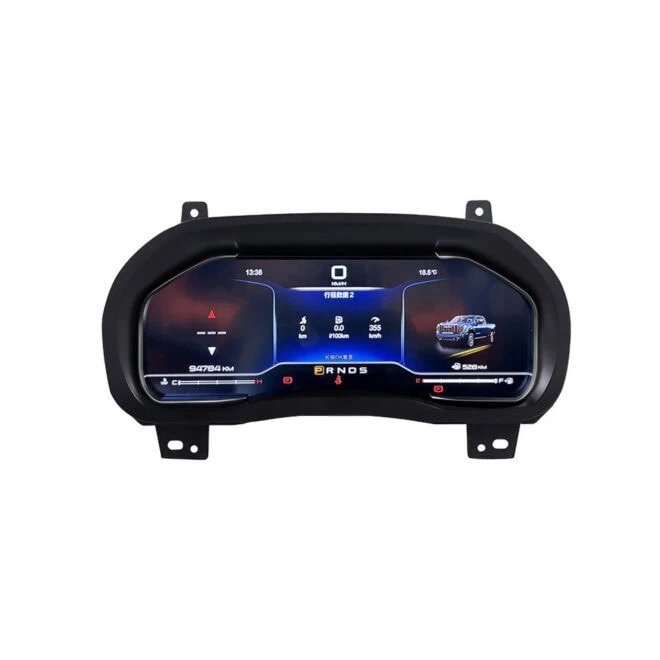
Universal aftermarket digital instrument clusters have become increasingly common in the marketplace, primarily online. These products are often marketed as easy “plug-and-play” upgrades for Silverado, Sierra, Tahoe, Yukon, Camaro and other GM vehicles, promising modern visuals and added features.
Despite their appearance, the majority of these universal aftermarket digital clusters do not function in an OEM-correct manner and frequently introduce reliability, safety, and compatibility issues.
This article addresses universal, non-OEM digital clusters commonly sold online, not OEM-correct aftermarket solutions engineered to GM specifications.
What Most Universal Aftermarket Digital Clusters Actually Are
Most universal aftermarket digital clusters are:
- Generic LCD panels paired with a universal control board
- Different housings to fit different vehicles (but same Generic Hardware)
- Designed to support many vehicles using as little development as possible
- Intercepting limited CAN data rather than participating as a vehicle module
- Not recognized by the vehicle as a true GM control module
They are not OEM GM clusters, and they do not operate as native GM components.
GM Instrument Clusters Are Control Modules — Not Displays
In modern GM vehicles, the instrument cluster is a full control module, not just a passive display.
OEM GM clusters are responsible for:
- Vehicle speed and tachometer display
- Warning and safety indicators
- Driver assistance alerts
- Steering wheel interaction feedback
- Security and immobilizer participation
- VIN-matched content configuration and behavior
- Displaying certain interfaces such as Trailer Brake Controller, PDR etc.
Universal aftermarket clusters do not meet these requirements, even if they appear visually similar.
Common Problems Seen With Universal Aftermarket Clusters
Owners frequently experience:
- Incorrect tachometer scaling (e.g., 8,000 RPM displays on 6,000 RPM engines)
- Mismatched or missing warning indicators
- Incorrect vehicle model shown on screen
- Interruption of factory module programming or other bus related issues
- Improper gear and drive mode display behavior
- Loss of factory driver alerts
- Loss of functionality for various subsystems
- Broken steering wheel interaction feedback
- Delayed or frozen screen updates
- Long key on boot times
- Dead battery from parasitic draw
- Diagnostic communication faults
These are not installation errors — they are design limitations.
One Interface Does Not Fit Every Vehicle
A major warning sign is the reuse of:
- The same UI across unrelated vehicles
- Loosely copying various GM UI from other vehicles
- Identical layouts regardless of engine or trim
- Generic graphics unrelated to GM or NTHSA design standards
OEM GM clusters are:
- VIN-specific
- Engine-specific
- Platform-specific
- Feature-aware
A visually impressive display does not equal correct vehicle integration.
Safety, Warranty, and Resale Implications
Because universal aftermarket clusters are not OEM modules:
- Safety warnings may not function correctly
- Odometer legitimacy may be questioned
- Driver alerts may be delayed or missing
- Diagnostic data may be unreliable
- Dealer servicing may be an issue
- Warranty and resale value may be affected
These risks are rarely disclosed in marketing materials.
Cost Reality: Universal Aftermarket vs OEM-Correct Solutions
Despite common assumptions, many universal aftermarket clusters:
- Cost more than OEM-correct upgrades
- Require additional adapters or harnesses
- Offer no long-term software support
- Provide no OEM-level warranty backing
- Come from a manufacturer no one has ever heard of
- Resellers are generally powerless for any support issues
OEM-correct cluster upgrades deliver:
- Proper system integration
- Long-term compatibility
- Preserved vehicle value
- Factory-grade reliability
The WAMS Position on Digital Cluster Upgrades
White Automotive & Media Services does not sell universal aftermarket digital clusters.
WAMS focuses exclusively on:
- OEM GM instrument clusters
- Platform-correct electrical architecture
- VIN-specific programming
- Factory behavior and appearance
- Long-term support viability
If a digital cluster cannot operate the way GM engineered it, WAMS does not consider it a valid solution.
Conclusion
Universal aftermarket digital clusters often look impressive but fall short where it matters most: proper vehicle integration.
Modern GM vehicles depend on tightly integrated control modules, and the instrument cluster plays a central role in safety, security, and driver interaction. Universal clusters generally cannot replicate this behavior and introduce risks that cannot be engineered away.
For owners seeking a true digital upgrade, OEM-correct solutions remain the only path that preserves functionality, safety, and long-term vehicle integrity.