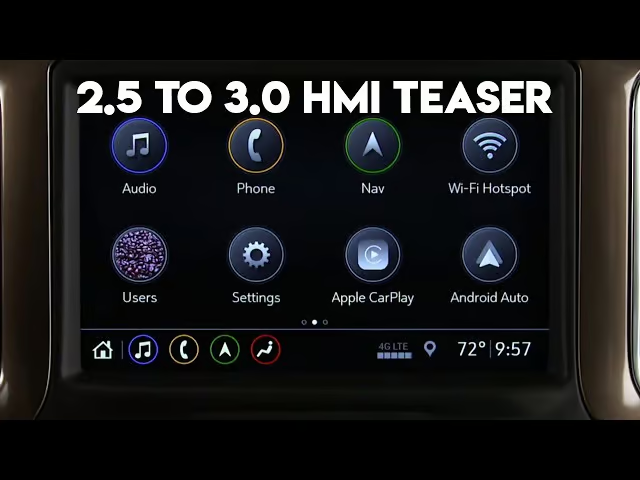
Why Doesn’t WAMS Offer an HMI 2.5 to HMI 3.x Upgrade?
At least once or twice a month, we’re asked some version of the same question:
“Why don’t you sell — or why aren’t you developing — an upgrade from HMI 1.1–2.5 to HMI 3.x?”
This question usually starts with a reference to an old video or forum post suggesting such an upgrade might be possible. The short answer is no — not in a way that would function correctly, reliably, and in an OEM-correct manner for the vast majority of GM vehicles.
The longer answer is that an upgrade like this was never realistically feasible on most platforms, and in the few edge cases where it could be forced, it required extreme cost, invasive vehicle modification, and significant compromise. That’s not something WAMS will put its name on.
The Fundamental Architectural Problem
HMI-based systems (HMI 1.1 through 2.5) and HMI 3.x systems are not evolutionary steps of the same design.
They are entirely different infotainment architectures.
HMI-based vehicles use:
- A separate HMI module
- A separate Radio (ACM) module
- A MOST bus ring topology
- Multiple modules on the MOST bus ring
HMI 3.x systems do not use this architecture at all.
1. Packaging: From Two Modules to One
HMI 3.0+ systems use a CSM (Center Stack Module) — a single integrated control module that replaces both the HMI and Radio.
This immediately creates multiple issues:
- No factory mounting location in HMI-based vehicles
- Different physical size and cooling requirements
- No direct replacement path for existing modules
This alone makes the swap non-OEM for nearly every platform.
2. Wiring: Completely Different Harness Design
Moving from HMI to CSM isn’t a module swap — it’s a wiring architecture change.
- HMI vehicles are wired for separate HMI and Radio modules
- CSM vehicles use an entirely different harness layout
- Associated modules (OnStar, amplifiers, displays) are wired differently
To do this correctly requires replacing or fabricating entire dash harnesses, not adapting connectors.
3. Network Type: MOST Bus vs Automotive Ethernet
HMI-based vehicles communicate infotainment data over a MOST bus ring.
CSM-based systems use Automotive Ethernet, with the CSM acting as the network master.
These network types are:
- Electrically incompatible
- Logically incompatible
- Architecturally incompatible
There is no bridge, adapter, or reprogramming solution that can convert one into the other.
4. Every Other Module Would Also Need Replacement
Once you move to Ethernet:
- Amplifiers must support Ethernet audio
- Camera systems must be digital (not analog)
- OnStar modules must be Ethernet-based
- Instrument Clusters must support Ethernet
This cascades into a full infotainment ecosystem replacement, not an upgrade.
5. Camera Systems Are Not Compatible
HMI vehicles use analog video for backup and surround cameras.
CSM vehicles use digital cameras, powered and communicated over coax.
This means:
- Existing cameras cannot be reused
- Camera modules and wiring must be replaced
- Calibration and integration complexity increases dramatically
“But I Know You’ve Done This Before…”
In a very small number of export Camaro builds, this was forced through at enormous expense.
What that required:
- Full dash removal
- Complete dash harness replacement (or custom fabrication)
- 2019+ instrument cluster with custom programming
- Ethernet-based amplifier
- New display, camera systems, and peripherals
- No OnStar (export vehicles only)
Even then, the cost and labor placed it far outside what most owners would consider reasonable — and those vehicles shared a platform generation that made the conversion barely possible.
Why This Is Even Less Feasible on Trucks and SUVs
For K2 trucks and SUVs, the barriers are even higher:
- Platform change from K2 to T1
- No compatible cluster form factor
- Loss of steering wheel control integration
- Physical and electrical incompatibility across the board
Without the correct cluster, OEM-style infotainment control is not achievable — full stop.
Why WAMS Never Offered This
Quite simply:
We do not sell solutions that “kind of work.”
If an upgrade:
- Breaks OEM behavior
- Requires invasive vehicle modification
- Depends on fragile workarounds
- Cannot be supported long-term
…it does not meet our standards.
Conclusion
An HMI 2.5 to HMI 3.x upgrade was never a realistic, OEM-correct path for most GM vehicles. The architectural differences are fundamental, not software-based, and cannot be overcome with programming alone.
WAMS focuses on upgrades that:
- Preserve factory behavior
- Maintain reliability
- Can be supported long-term
- Deliver predictable results
This is why some ideas should remain forum discussions — not products.