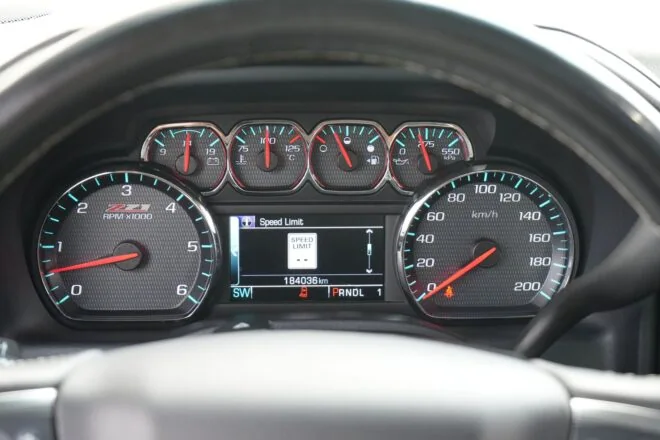
Owners of GM vehicles imported from Canada are often surprised when the instrument cluster doesn’t behave or display information correctly after U.S. registration. Common complaints include speed shown primarily in kilometers per hour, temperature in Celsius, bilingual or unfamiliar warning messages, and regulatory icons that don’t match U.S. standards.
This is not a defect and not a programming mistake. It is the result of Canadian-spec instrumentation hardware being installed in a vehicle now operating under U.S. requirements.
This tech note explains why Canadian-spec GM instrument clusters behave differently, why these differences cannot be fully corrected through simple face swaps, and how an OEM-correct cluster replacement resolves the issue properly.
What Makes a Canadian-Spec GM Instrument Cluster Different?
GM does not use a single universal instrument cluster for all markets. Canadian-spec clusters are built and validated to meet Canadian regulatory, metric, and language requirements, which differ from U.S. specifications.
Common differences include:
- Speedometer scaling prioritizing km/h
- Temperature display in Celsius
- Market-specific warning icons and messages
- Bilingual or region-specific text
- Regulatory indicators not used in U.S. vehicles
These behaviors are designed into the cluster hardware and firmware, not simply toggled by a setting.
Why Face Swaps Alone Does Not Fix the Problem
A common assumption is that the cluster can simply be “Face Swapped” or reconfigured to behave like a U.S.-spec unit. Unfortunately, that is not how modern GM clusters work.
GM instrument clusters are control modules, not passive displays. They contain:
- Market-specific firmware
- Region-specific regulatory logic
- Hard-coded display behavior
- Safety and compliance expectations tied to the original build market
Face swapping alone doesnt fix the underlying problem of incorrect units, scaling, icons etc.
Attempting to force a Canadian cluster into U.S. behavior often results in:
- Partial unit conversion with inconsistent scaling
- Persistent Canadian warnings or symbols
- Incorrect driver alerts
- Non-compliant display behavior
The OEM-Correct Solution: U.S.-Spec Cluster Replacement
The correct way to resolve Canadian-to-U.S. cluster issues is to replace the Canadian-spec unit with a proper U.S.-spec OEM GM instrument cluster.
A correct replacement cluster:
- Displays speed in mph with proper scaling
- Uses Fahrenheit temperature units
- Shows U.S.-correct warning icons and messages
- Matches U.S. regulatory and safety expectations
- Integrates cleanly with the vehicle’s existing systems
When sourced and programmed correctly, the vehicle behaves exactly like a U.S.-delivered model.
Why This Is a Better Alternative Than Living With It
Many imported vehicles are otherwise mechanically perfect, but the incorrect cluster behavior is a constant reminder that something isn’t quite right.
A proper cluster replacement:
- Improves daily drivability
- Eliminates confusion and misreadings
- Restores factory-correct appearance
- Preserves resale value
- Avoids questionable third-party conversion hacks
For owners planning to keep the vehicle long-term, this is the cleanest and most correct fix.
Important Notes
- This is not a cosmetic overlay or software trick
- This is not a universal aftermarket cluster
- Vehicle-specific programming is required
- Cluster replacement ensures full OEM behavior
- Results match factory U.S.-spec vehicles
Conclusion
Canadian-spec GM instrument clusters are built differently for a reason. When those vehicles are imported into the U.S., the cluster often becomes the last visible reminder of that difference.
Reprogramming cannot fully resolve these issues. A U.S.-spec OEM cluster replacement is the correct and permanent solution, restoring proper units, warnings, and driver information exactly as GM intended for U.S. vehicles.