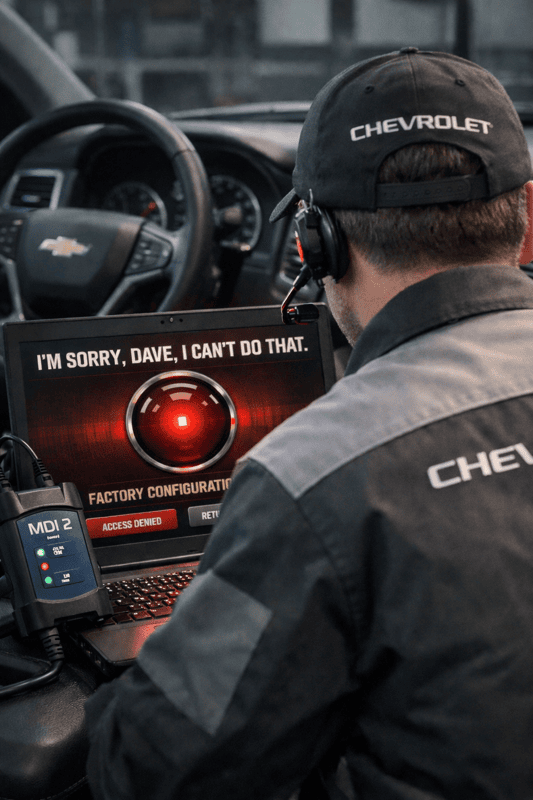
One of the most common misconceptions surrounding GM vehicle upgrades is the belief that a dealership can simply “program” new features after a retrofit or swap.
This advice is frequently repeated by forums, sellers, and even AI-generated answers — yet in practice, it is incorrect in the vast majority of cases.
This Tech Note explains what GM dealership programming is actually designed to do, why most retrofits fall outside its scope, and the very limited scenarios where small configuration changes may be permitted.
What GM Dealership Programming Is Designed to Do
GM dealerships use GM’s official Service Programming System (SPS) and related tools to perform programming tasks that are strictly tied to a vehicle’s VIN and original build configuration.
Dealer programming is intended to:
- Restore a vehicle to its factory “as-built” state
- Replace failed modules with identical factory-equivalent units
- Perform required relearns and security handshakes
- Validate system integrity against GM’s backend databases
In short, dealership programming enforces factory configuration — it does not create new ones.
VIN Locking and As-Built Enforcement
Every modern GM vehicle has a VIN-linked configuration derived from:
- Regular Production Option (RPO) codes
- Platform architecture (Global A, Global B, etc.)
- Approved module combinations
- Feature dependencies and combinations validated by GM
When a dealer programs a module, SPS compares the vehicle’s current state to what GM expects that VIN to contain. If hardware or features fall outside that expected configuration, SPS will typically:
- Remove unsupported features
- Revert settings to factory defaults
- Reject the configuration entirely
- Leave the module in an inoperative state
This is why many retrofits appear to “lose” features after dealer programming.
Why Most Retrofits Cannot Be Supported by Dealers
Retrofits and swaps commonly fail at dealerships because they involve one or more of the following:
- Hardware not originally offered on that VIN
- Features introduced in later model years
- Architecture changes between platforms
- Modules that require behavior GM never approved for that vehicle
Examples include:
- Instrument cluster upgrades
- Infotainment system upgrades
- CarPlay / Android Auto retrofits
- Camera system changes
- Steering wheel or control interface upgrades
Even when the physical hardware fits and powers on, GM’s programming systems are not designed to authorize those changes.
The Rare Exception: VCI Numbers and Controlled Changes
In very limited circumstances, GM may issue a VCI (Vehicle Configuration Index) number to allow a small, tightly controlled configuration change.
These situations typically involve:
- Same model year
- Same platform architecture
- Identical underlying hardware families
- Minor configuration adjustments (not feature additions)
VCI-based changes are:
- Rare
- Explicitly authorized by GM
- Limited in scope
- Not applicable to most retrofit scenarios
Importantly, VCI numbers do not enable broad customization and are not a general-purpose retrofit solution. They exist to resolve narrow production or service edge cases — not to add features a vehicle was never built to support.
Why “The Dealer Can Program It” Is Usually Incorrect
When someone says a dealer can program a retrofit, they are usually conflating:
- Module replacement programming
- Security relearns
- Calibration procedures
with custom feature enablement, which dealerships do not perform.
Dealers cannot:
- Add unsupported features
- Override platform limitations
- Re-engineer system behavior
- Force GM systems to accept non-approved configurations
Their tools are designed to validate, not customize.
How OEM-Correct Retrofits Are Actually Supported
Proper OEM-style retrofits require work that happens outside dealership programming systems, including:
- VIN-specific off-vehicle custom programming
- Architecture-aware module configuration
- Specific vetted hardware/software combinations
This is fundamentally different from dealership programming, which operates entirely within GM’s locked service environment.
Summary
GM dealerships play a critical role in vehicle service and warranty support — but their programming tools are not designed to support most retrofit or swap scenarios.
With rare, tightly controlled exceptions involving VCI numbers, dealership programming exists to restore factory configuration, not redefine it.
Understanding this distinction helps avoid incorrect advice, failed retrofits, and unnecessary service visits.