
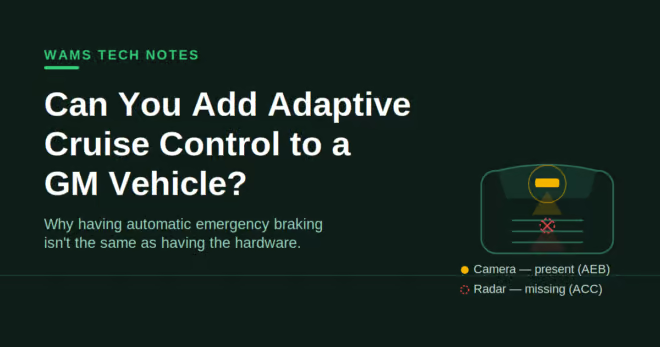
Short answer: No — and there are two reasons, either of which is enough on its own. First, WAMS does not modify, enable, or retrofit safety or driver-assistance systems, and adaptive cruise control (ACC) is one of them. Second, a GM vehicle that didn’t come with adaptive cruise is genuinely missing the hardware to run it — not just a software flag, but physical modules, often a different camera, frequently a radar unit, the supporting wiring, and the calibration that ties them together. We get this question regularly — most recently from a 2024 Silverado HD owner who had automatic emergency braking and assumed that meant the hardware for adaptive cruise was already aboard. It’s an understandable assumption. Here’s exactly why it isn’t the case.
“But my vehicle has automatic emergency braking — doesn’t it already have the hardware?”
This is the heart of the confusion, and it’s a fair one. Your vehicle brakes itself when it senses an obstacle, so it clearly has sensors — surely adaptive cruise is just switching on a feature that uses them?
The catch is that automatic emergency braking and adaptive cruise control are different systems, and GM treats them as distinct enough to assign separate option (RPO) codes. Adaptive cruise control carries RPO KSG (or K59 on some platforms, such as certain K2 SUVs), while base automatic emergency braking is RPO UHY and the radar-based enhanced braking system is RPO UGN. Here’s the part that matters: base automatic emergency braking (UHY) uses only the windshield camera. So a vehicle with automatic emergency braking but no adaptive cruise has, at most, a camera built for braking duty — not the full set of hardware adaptive cruise was designed around. Having one system does not mean you have the hardware for the other.
Adaptive cruise isn’t one thing — and the hardware varies by vehicle
Part of what makes this confusing is that GM builds adaptive cruise in more than one configuration, and which one a given vehicle uses isn’t consistent across the lineup. The fuller version — the one most people picture, which can slow you to a stop and resume in traffic — leans on a forward-facing Long Range Radar Sensor Module, together with the Active Safety Control Module and the windshield camera, all working as a set. There’s also a camera-based version of adaptive cruise that operates without the long-range radar.
And here’s the thing people expect to be tidy that simply isn’t: which configuration a vehicle got doesn’t break down cleanly by body style. Some trucks use the camera-based setup; some SUVs use the radar-based one; it varies by model, trim, and model year. There is no reliable “trucks get this, SUVs get that” rule. That’s not a detail we can hand-wave — it’s the whole reason the only trustworthy way to know what your specific vehicle has (or could even theoretically support) is its RPO build code, not a guess based on what kind of vehicle it is.
What stays constant through all that variation: a vehicle built with automatic emergency braking only does not have an adaptive-cruise configuration of any kind. It has a camera doing braking duty — not the adaptive-cruise control logic, not the radar where that version uses one, and as we’ll see, often not even the right camera.
How GM actually builds a vehicle
To understand why the hardware genuinely isn’t there, it helps to understand how GM builds vehicles. With very few low-volume exceptions, GM does not install hardware or wiring that a vehicle won’t use. This isn’t a casual tendency — it’s a discipline. GM will delete a single wire from a harness to save a fraction of a cent per vehicle, because across millions of units that fraction becomes real money, and there are entire teams whose job is to find and remove exactly that kind of unused cost.
So the intuition that “the wiring is probably already in there, just waiting to be switched on” is backwards. If your vehicle was not built with adaptive cruise, GM made sure it does not carry the hardware that version needs, or the harness to connect it — because leaving any of that in would have cost them money for a feature you didn’t order. The absence isn’t an oversight. It’s engineered.
What’s actually missing on a vehicle not built for adaptive cruise
What’s missing depends on the platform and the version of adaptive cruise involved, but it generally comes down to some combination of these:
- The front camera is frequently a different part — even for the same vehicle line. GM’s own parts catalog shows the windshield camera changing with the driver-assist tier a vehicle was built to: a base-tier camera carries a different part number than the camera used on radar-enhanced or Super Cruise builds, and several of those cameras explicitly require programming or setup. They aren’t interchangeable, and on many platforms they don’t even share the same connector — GM keys them so the factory installs the correct one and the wrong one can’t be plugged in. The camera you have may simply be the wrong camera for the job.
- The Active Safety Control Module is missing. The radar-based version of adaptive cruise relies on the Active Safety Control Module (ASCM) — the module that takes the sensor inputs and commands the vehicle’s response. A vehicle built without that version doesn’t have it.
- Where the version uses radar, the Long Range Radar Sensor Module doesn’t exist. This is the forward radar that measures the distance to the vehicle ahead — on most vehicles in the center grille behind the brand emblem, on some behind the lower fascia. On a vehicle not built for the radar version, it and its harness are simply absent.
- And that’s only the hardware. Sourcing and fitting every part above still leaves the harder problem — the modules already in your vehicle have no idea any of it exists. More on that below.
This applies to any GM vehicle — not just trucks
Although we see this question most from truck owners, the same reality applies to any GM vehicle that offered adaptive cruise as a factory option. A Tahoe, Suburban, or Yukon; an Acadia, Traverse, or Enclave; a Cadillac; a car like a Malibu or a former Impala — if it was built without adaptive cruise, it faces the same kind of hardware gap as a Silverado or Sierra. What differs is the detail, and it differs a lot. GM’s older Global A electrical architecture and the newer Global B — also called the Vehicle Intelligence Platform, which arrived on the 2020 C8 Corvette/CT4/CT5 and has since spread across the lineup — handle these systems differently, and even within one architecture the specific parts vary by model and year. There is no single universal parts list, and no shortcut around checking the actual vehicle. But the conclusion is identical across all of them.
The part nobody thinks about: the modules already in your vehicle
Suppose you did the hard work — sourced the correct camera, added the radar and its harness where the version needs one, added the control module. You’re still not close, because adaptive cruise isn’t a self-contained box you bolt on. It actively commands your vehicle’s throttle and brakes, which means it has to be woven into the modules that already run those systems. And right now, every one of those modules was configured at the factory for a vehicle that does not have adaptive cruise. As far as they’re concerned, the system doesn’t exist.
So beyond the new hardware, a working retrofit would require reconfiguring and recalibrating a range of modules that currently function perfectly — broadly, the systems that manage braking, propulsion, body electronics, and the instrument display, among others. And the new safety hardware itself can’t simply be bolted on: per GM’s own service requirements, components like the windshield camera and the Long Range Radar Sensor Module require SPS programming and a calibration “learn” after installation — the radar has to be aimed and the camera taught to see, under specific driving conditions, before the system will trust either one. Each module has to be told the vehicle now has this system, how to talk to it, and how to respond to its commands. The exact set varies by vehicle and architecture, but the principle holds across all of them: you are not adding an island, you are rewiring the logic of systems throughout the vehicle.
That’s where the real risk lives. Every one of those modules works correctly today. Reconfiguring all of them to accommodate a system the vehicle was never built with means putting working systems — your brakes, your throttle, your body controls — into a configuration they were never validated in. If any single one doesn’t take the change cleanly, or GM’s programming refuses it partway through, you’re not left with a vehicle that simply lacks adaptive cruise. You’re left with one that may no longer behave the way it did before you started. That is a steep gamble to take with the systems that stop and move your vehicle.
“But anything’s possible with enough time and money…”
True — and we won’t pretend otherwise. In principle, you could identify the correct configuration for your platform, source the right camera, add the radar and harness if that version uses one, add the control module, and attempt to configure everything. The problem isn’t that it’s literally impossible; it’s that the amount of work makes no economic sense. By the time you’ve bought the modules, fabricated and run the wiring, and paid for the configuration and calibration labor across every affected system, you’d have spent more than the difference between your vehicle and one that left the factory with adaptive cruise.
That’s the honest bottom line: it is cheaper to sell your vehicle and buy the one that came with adaptive cruise control than to attempt to add it. “Buy the one that has it” isn’t a brush-off — it’s the math.
And there’s a wall waiting even for someone willing to spend anyway: GM’s programming systems. As we explain in why GM dealers can’t program retrofits, GM’s SPS programming compares a vehicle against the configuration GM expects for that VIN and rejects hardware and features that fall outside it. The narrow VCI path GM occasionally uses to authorize a configuration change is not a general-purpose retrofit tool. So even a fully assembled hardware retrofit can be refused at the programming stage.
It’s not just a policy wall, either — it shows up in the diagnostics. GM’s own service information ties a specific software-configuration code — B101E — to the Active Safety Control Module in this exact context. It’s the same family of trouble code we cover in our note on B101E and U0028: the vehicle’s modules expect a configuration that matches the VIN, and they flag it when one doesn’t. A module that isn’t properly provisioned for the vehicle doesn’t quietly work anyway — it sets faults.
Why WAMS won’t do it regardless
Set the cost and the programming wall aside, and there’s still a firm line: WAMS does not modify, enable, or retrofit safety or driver-assistance systems — adaptive cruise control, automatic emergency braking, lane keep assist, Super Cruise, or any other. Adaptive cruise actively controls your vehicle’s throttle and brakes based on what its sensors read from the road. A system like that, assembled from mixed hardware and reconfigured across modules outside the factory process it was designed for, is a genuine safety risk — not a place for “close enough.” We’d rather tell you no than hand you a driver-assistance system we can’t stand behind.
What we can help with
If what you’re really after is a more modern, better-equipped vehicle, there’s plenty we do do — just not on the safety side. WAMS specializes in factory-grade infotainment and convenience upgrades: Apple CarPlay and Android Auto retrofits, digital instrument cluster upgrades, larger infotainment screens, and VIN-specific programming for non-safety features your vehicle can legitimately support. If you’d like to modernize your GM vehicle in ways that are actually feasible, that’s exactly our lane.
Frequently asked
Can you add adaptive cruise control to a GM vehicle that didn’t come with it?
Not practically, and not at WAMS. A GM vehicle built without adaptive cruise is missing the hardware that version needs — which can include a different front camera, the Active Safety Control Module, a Long Range Radar Sensor Module, and the wiring for all of it — and WAMS does not retrofit safety or driver-assistance systems regardless.
I have automatic emergency braking — doesn’t that mean I have the hardware for adaptive cruise?
No. Base automatic emergency braking (RPO UHY) runs off the windshield camera only, and that camera is frequently a different part than the one an adaptive-cruise build uses. Adaptive cruise (RPO KSG, or K59 on some platforms) requires its own configuration — and on many vehicles a forward-facing radar — that an AEB-only vehicle doesn’t have. Having one system doesn’t provide the hardware for the other.
Isn’t adaptive cruise control just a software activation?
No. With very few exceptions, GM doesn’t build in hardware or wiring a vehicle won’t use, so a non-ACC vehicle genuinely lacks the camera, module, wiring, and — where the version uses one — the radar. There’s no dormant system waiting to be switched on.
How do I know which adaptive cruise setup my GM vehicle would need?
It varies by model, trim, and year — there’s no reliable rule based on whether you drive a truck, SUV, or car, since some trucks use a camera-based version and some SUVs use a radar-based one. The only dependable indicator is the vehicle’s RPO build code, which is why guessing from body style leads people astray.
Even if I add the radar and camera, why won’t it just work?
Because adaptive cruise controls the throttle and brakes, it has to be integrated with modules that already run those systems — braking, propulsion, body electronics, and the instrument display, among others — all configured for a vehicle without it. On top of that, GM requires SPS programming and a calibration learn on the new hardware. Reconfiguring working systems outside the factory process risks the systems that already function correctly, which is part of why it isn’t worth attempting.
Does WAMS retrofit adaptive cruise control or other safety systems?
No. WAMS does not modify, enable, or retrofit safety or driver-assistance systems such as adaptive cruise control, automatic emergency braking, lane keep assist, or Super Cruise. We focus on infotainment, cluster, and other non-safety upgrades.
What about aftermarket systems like Comma?
One clarification, because it comes up: everything above is about adding genuine GM factory adaptive cruise control — the real system, built from GM’s hardware and integrated the way the vehicle was engineered to use it. That’s a separate question from third-party driver-assistance add-ons.
You may have seen aftermarket systems — Comma’s openpilot is the best known — that add adaptive-cruise-like and lane-centering behavior by tapping into a vehicle’s existing camera and data bus. These are real, and they’re clever, but they are not GM factory adaptive cruise control. They’re a separate third-party system with their own hardware, their own supported-vehicle list, their own limitations, and their own safety and liability considerations — and they are explicitly not something WAMS installs, supports, or recommends. Our position on driver-assistance systems doesn’t change based on who made them: we don’t touch them. If you’re weighing one, that’s a decision to research carefully and take up directly with that product’s maker — it isn’t a factory-equivalent retrofit, and it isn’t something we can help with.
Frequently asked Questions
Can you add adaptive cruise control to a GM vehicle that didn’t come with it?
Not practically, and not at WAMS. A GM vehicle built without adaptive cruise is missing the hardware that version needs — which can include a different front camera, the Active Safety Control Module, a Long Range Radar Sensor Module, and the wiring for all of it — and WAMS does not retrofit safety or driver-assistance systems regardless.
I have automatic emergency braking — doesn’t that mean I have the hardware for adaptive cruise?
No. Base automatic emergency braking (RPO UHY) runs off the windshield camera only, and that camera is frequently a different part than the one an adaptive-cruise build uses. Adaptive cruise (RPO KSG, or K59 on some platforms) requires its own configuration — and on many vehicles a forward-facing radar — that an AEB-only vehicle doesn’t have. Having one system doesn’t provide the hardware for the other.
Isn’t adaptive cruise control just a software activation?
No. With very few exceptions, GM doesn’t build in hardware or wiring a vehicle won’t use, so a non-ACC vehicle genuinely lacks the camera, module, wiring, and — where the version uses one — the radar. There’s no dormant system waiting to be switched on.
How do I know which adaptive cruise setup my GM vehicle would need?
It varies by model, trim, and year — there’s no reliable rule based on whether you drive a truck, SUV, or car, since some trucks use a camera-based version and some SUVs use a radar-based one. The only dependable indicator is the vehicle’s RPO build code, which is why guessing from body style leads people astray.
Even if I add the radar and camera, why won’t it just work?
Because adaptive cruise controls the throttle and brakes, it has to be integrated with modules that already run those systems — braking, propulsion, body electronics, and the instrument display, among others — all configured for a vehicle without it. On top of that, GM requires SPS programming and a calibration learn on the new hardware. Reconfiguring working systems outside the factory process risks the systems that already function correctly, which is part of why it isn’t worth attempting.
Can’t I just use an aftermarket system like Comma instead?
Aftermarket driver-assistance systems such as Comma’s openpilot exist and use a vehicle’s existing camera and data, but they are not GM factory adaptive cruise control — they’re a separate third-party system with their own hardware, limitations, and safety and liability considerations. WAMS doesn’t install, support, or recommend them; our policy on driver-assistance systems applies regardless of who makes them.
Does WAMS retrofit adaptive cruise control or other safety systems?
No. WAMS does not modify, enable, or retrofit safety or driver-assistance systems such as adaptive cruise control, automatic emergency braking, lane keep assist, or Super Cruise. We focus on infotainment, cluster, and other non-safety upgrades.